
Contact & Online-Based Teaching
Introduction
UJ follows a blended learning approach. According to UJ'sAcademic Programme Policy Senate blended learning is contact learning with some distance- based online support. For example, face-to-face teaching methods are used with technologically mediated materials, learning activities, educational software, and print materials.
Many of us have had much more exposure to online teaching due to the COVID-19 pandemic. Now, we follow a more blended hybrid teaching model encompassing contact and online teaching elements.
What are the components of good contact and online lecturing that facilitate learning?
To ensure that you are adequately preparing for all your lectures whether they be contact or face-to- face, it is good to remind yourself of UJ's principles which outline the University's commitment to fostering excellence in teaching and learning and apply equally to all teaching and learning activities. Here is the link toUJ Teaching & Learning Policy
The following sections provide different tips on how to enhance student learning - the respective books are listed below under the Books/Guides section:
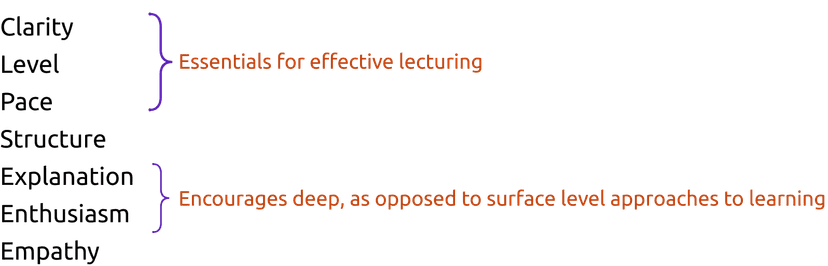
7 Aspects that are considered essential for student learning:
Do your lectures incorporate these 7 aspects that are considered essential for student learning (Entwistle, 2000)
Learner-centred teaching
- The Balance of Power
- The Function of Content
- The Role of the Teacher
- The Responsibility of Learning
- The Purposes and Processes of Evaluation
The Australian Learning and Teaching Council Awards (2008)refer to the following as essential aspects of lecturing:
- Are my students actively engaged in learning?
- Am I building on my students' prior knowledge and experience?
- Are my teaching practices catering for student diversity? Does it cater for:
- Are my students encouraged to develop and expand their conceptual understanding?
- Am I actively making my students aware of key learning outcomes?
- Do I actively link research and teaching?
- Do I present the content logically?
- Are my learning outcomes and presentation information linked?
- Do I seek feedback on my student's understanding and act on this accordingly?
- Do I use student discussions and student-to-student interactive sessions in my lectures?
Additional resources
- Massachusetts Institute of Technology (MIT)Teaching and Learning Laboratory
- Derek Bok Centre for Teaching and Learning - Harvard University
- Bain, K. (2004). What the Best College Teachers Do. ..\HETLReviewVolume2Article1 What the best college teachers do Bain interview.pdf - Cambridge MA: Harvard University Press
Book/Guides
- Marshall, S. (2020). A Handbook for Teaching and Learning in Higher Education, 5 th ed. Routledge
- Refer to Ken Bain's What do the Best College Teachers Do as an excellent resource to enhance your teaching.
- Entwistle, N.J. (2000). Approaches to Studying and Levels of understanding: The Influences of Teaching and Assessment. In Higher Education: Handbook of Theory and Research, Vol 15, ed. J.C.Smart. New York: Agathon Press
- Weimer, M. (2002).Learner- Centered Teaching. Five Key Changes to Practice. San Francisco: Jossey- Bass, John Wiley & Sons, Inc.
UJ Resources
UJ has many divisions that provide support and training in all areas of contact and online teaching.
Here are some:
- Centre for Academic Technologies (CAT) - they provide support for online teaching and learning through lectures and seminars on how to use Blackboard, setting up collaboration for lectures, holistic teaching and learning presence and many more. They also provide online support to set up learning modules on Blackboard. They can be contacted atcatonline@uj.ac.za
- Division of Teaching Excellence (DoTE) - they provide lectures and seminars on learning with technology, working with tutors, innovation in teaching and many more topics. They also cover several masterclasses on topics like sustainable development, community engagement, and politics of language. Here is their email address:dote@uj.ac.za